Key Takeaways
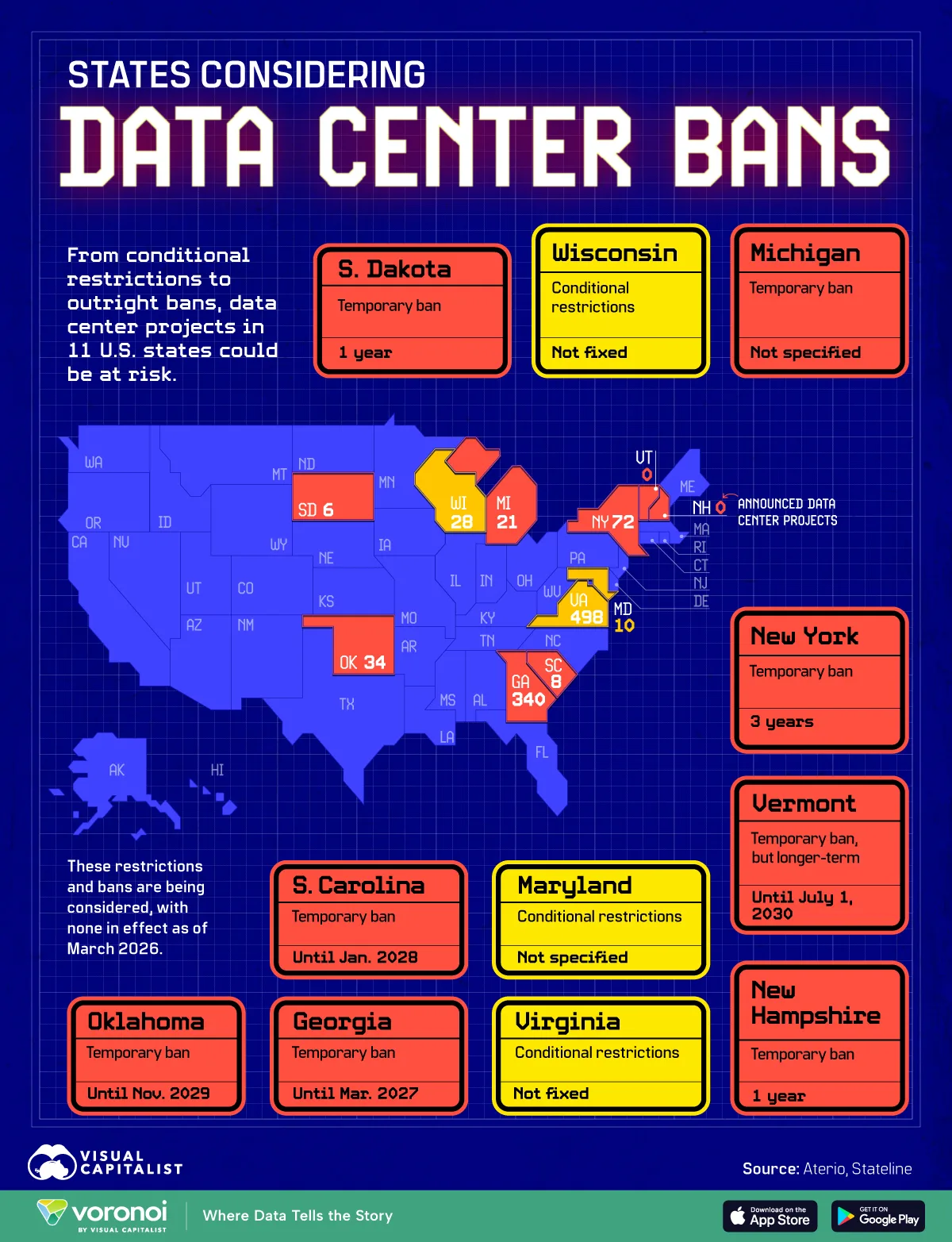
- There are 11 U.S. states considering bans and restrictions on data centers, with some calling for studies on their impact.
- Virginia is a data center hotspot with 498 facilities planned, but lawmakers are hoping to apply conditional restrictions on new sites.
- No new data centers are slated for Vermont and New Hampshire, but both states are taking preemptive action on construction.
The rapid expansion of data centers is being met with a growing number of possible restrictions across U.S. states.
Key Impacts of Data Centers
The primary concerns revolve around the sheer scale of resources these facilities consume, which often competes with the needs of local residents.
- Grid Strain & Energy Costs: A single large AI data center can consume as much electricity as 100,000 homes. This surge in demand has forced utilities to delay retiring coal plants or build new gas turbines, undermining climate goals. In many regions, these infrastructure costs are passed on to ordinary residents, leading to significant hikes in utility bills.
- Water Scarcity: Data centers require millions of gallons of water daily for cooling. In drought-prone or high-density areas, this places immense pressure on local drinking water supplies. Estimates for 2028 suggest AI data centers could require up to 32 billion gallons of water annually in the US alone.
- Environmental Justice & Pollution: Facilities often rely on diesel backup generators that emit high levels of nitrogen oxides and particulate matter, linked to respiratory issues. Furthermore, there is a trend of “clustering” these centers in marginalized communities that already face high environmental burdens.
- Land Use & Noise: Massive “warehouse-scale” campuses (often 100–1,000 acres) are replacing agricultural land and forests. Additionally, the constant hum from industrial cooling fans and equipment can reach 85–100 decibels, disrupting nearby residential areas.